
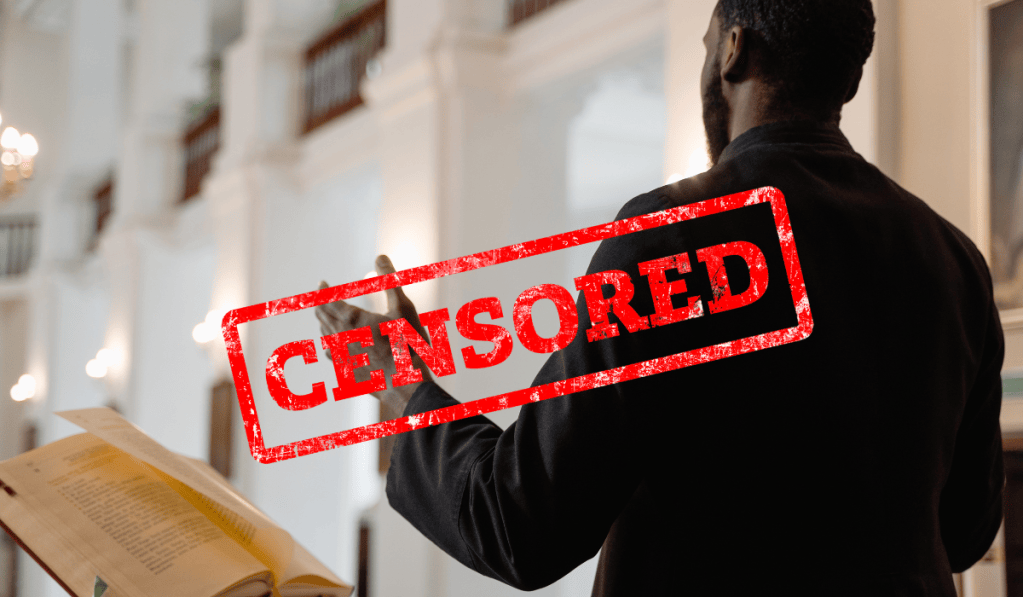
Pulpit Censorship: Part II – The Biblical Mandate to Proclaim the Whole Counsel of God
Rev. Dr. Sanette Fleming, DMin (ABD), MDiv
President, I Was Just Thinking Ministries Inc.
“For I did not shrink from declaring to you the whole counsel of God.”
—Acts 20:27, ESV
“Preach the word; be ready in season and out of season; reprove, rebuke, and exhort, with complete patience and teaching.”
—2 Timothy 4:2, ESV
Introduction: Truth in Season and Out
The modern preacher stands at a precipice. If Part I of this series explored the rising cultural and legal threat to religious speech, Part II defends the divine imperative to preach the entirety of God’s revelation, without compromise. The Messianic calling to uphold both the Tanakh and the B’rit Chadasha (New Covenant) demands a fidelity that transcends legal threats and social backlash.
Whether facing Roman prisons or modern cancel culture, Biblical preachers are called to herald the truth of God’s Word—not only the comforting parts, but the convicting ones as well. The mandate to declare the “whole counsel of God” (πᾶσαν τὴν βουλὴν τοῦ θεοῦ) is not optional. It is central to Biblical faithfulness, pastoral integrity, and public witness.
Exegetical Foundations: What Is “The Whole Counsel of God”?
The phrase “whole counsel of God” (Acts 20:27) comes from Paul’s farewell address to the Ephesian elders. The Greek word βουλή (boulē) refers to a deliberate plan or purpose.⁽¹⁾ Paul’s use of the term implies the totality of God’s redemptive plan, from Genesis to Revelation. This includes:
- The nature of God (Exod. 34:6-7; John 1:1-14)
- The holiness and justice of God (Lev. 11:44; Rom. 3:23-26)
- The call to repentance (Ezek. 18:30; Acts 17:30)
- The reality of judgment (Matt. 25:31-46; Rev. 20:11-15)
- The exclusivity of salvation through Yeshua (John 14:6; Acts 4:12)
To “declare” the whole counsel (ἀναγγέλλω – anangellō) means to fully announce or disclose something without withholding any part. Paul warned Timothy that there would be a time when people would no longer tolerate sound teaching but instead gather teachers who suit their own passions (2 Tim. 4:3-4). We are in that time.
Theologian John Stott warned decades ago that selective preaching would soon become “the curse of the church,” wherein only the pleasant and palatable are preached, leaving out “the hard truths which alone can save.”⁽²⁾
Historical Witnesses: Preachers Who Paid the Price
Faithful preachers in both Jewish and Christian history have faced social and political hostility. From Jeremiah’s imprisonment (Jer. 37:15-16) to Stephen’s martyrdom (Acts 7) to Jan Hus, who was burned at the stake on July 6, 1415, in Constance, Germany(now Konstanz), during the Council of Constance, bold proclamation has always come at a price.
In the post-Constantinian era, leaders who became known as “Church fathers” like John Chrysostom and Athanasius were exiled for refusing to compromise with imperial or theological powers.⁽³⁾ The Reformation was born from a rediscovery of the full counsel of Scripture, including uncomfortable doctrines about sin and authority.
Even in the American context, preachers like Lemuel Haynes, Jonathan Edwards, and Martin Luther King Jr. faced public backlash for preaching messages grounded in Biblical justice and theological conviction. Their legacy affirms that preaching must be Biblical, not merely popular.
Messianic Mandate: The Law, the Prophets, and the Messiah
Messianic believers are uniquely positioned in this debate. We affirm the continuity of God’s covenantal purposes and the authority of Torah, Nevi’im, and Ketuvim (Tanakh), along with the B’rit Chadashah (New Covenant writings). We do not unhitch the Gospel from the Tanakh (Old Testament) but reveal its fulfilment in Yeshua (Luke 24:27).

Yeshua Himself preached the fullness of God’s counsel:
- He quoted Deuteronomy against the devil (Matt. 4:1-10)
- He affirmed the permanence of Torah (Matt. 5:17-19)
- He rebuked sin and hypocrisy (Matt. 23)
- He prophesied judgment and redemption (Matt. 24-25)
As Messianic teachers, our bimah or pulpit duty includes proclaiming the whole narrative of redemption: from Pesach (Passover) to Sukkot (Feast of Tabernacles), from the Fall leading to separation to redemption leading to life everlasting in the Father’s house. To preach only “love” and not “truth,” only “healing” and not “repentance,” is to mutilate the message of God.
Contemporary Implications: Pastoral Cowardice or Cultural Compassion?
Today, many pastors justify omitting hard truths for the sake of “compassion”, or “cultural relevance,” or “meeting people where they are at.” But Biblical compassion and “meeting people where they are at” do not eliminate Biblical conviction. As Bonhoeffer lamented in Nazi Germany, the Church became “silent when it should have cried out.”⁽⁴⁾
C.S. Lewis noted that the preacher must not “water down Christianity.” He wrote: “If you want a religion to make you feel really comfortable, I certainly don’t recommend Christianity.”⁽⁵⁾
In pastoral counseling and in public preaching, compromise on clear Scripture—especially on issues like sexuality (Lev. 18:22; Rom. 1:26–32), the sanctity of life (Gen. 9:6; Ps. 139:13–16), or the exclusivity of Yeshua HaMashiach (Jesus the Messiah, John 3:18)—is not compassion. It is spiritual malpractice.
Doctrinal Consequences: When Preachers Become Editors

Theological drift always begins with silence. When pastors become editors instead of heralds of the Word, they end up shaping Scripture to fit culture, instead of calling culture to submit to Scripture.
The prophet Isaiah warned: “Woe to those who call evil good and good evil…” (Isa. 5:20)
Paul instructed Timothy to “guard the good deposit” (2 Tim. 1:14), not revise it. When the synagogue and church rewrite God’s message to avoid offence, both abandon their prophetic role and violate their marriage covenant with the Messiah. The faithful preacher is not called to popularity but to proclamation—in season and out.
Conclusion: A Call to Faithful Proclamation
In this generation of increased hostility toward Biblical truth, pastors, rabbis, and spiritual leaders must recover the mantle of boldness. We must resolve, like Paul, not to shrink back from declaring the full counsel of God.
To do otherwise is to betray the very Gospel that saved us—and the Messiah who commissioned us.
Suggested Reading
- Stott, John. Between Two Worlds: The Challenge of Preaching Today. Grand Rapids: Eerdmans, 1982.
- Bonhoeffer, Dietrich. The Cost of Discipleship. New York: Macmillan, 1959.
- Lewis, C.S. God in the Dock: Essays on Theology and Ethics. Grand Rapids: Eerdmans, 1970.
- Kaiser, Walter C. Jr. Preaching and Teaching from the Old Testament. Grand Rapids: Baker Academic, 2003.
- Feinberg, Charles L. The Prophets as Preachers. Chicago: Moody Press, 1970.
Footnotes
- William Arndt et al., A Greek-English Lexicon of the New Testament and Other Early Christian Literature, 3rd ed. (Chicago: University of Chicago Press, 2000), 176.
- John Stott, Between Two Worlds: The Challenge of Preaching Today (Grand Rapids: Eerdmans, 1982), 144.
- Jaroslav Pelikan, The Christian Tradition: A History of the Development of Doctrine, Vol. 1 (Chicago: University of Chicago Press, 1971), 254–260.
- Dietrich Bonhoeffer, The Cost of Discipleship (New York: Macmillan, 1959), 87.
- C.S. Lewis, God in the Dock: Essays on Theology and Ethics (Grand Rapids: Eerdmans, 1970), 101.
Next in the Series:
Part III – When the Gospel Offends: Legal Risks, Church Strategy, and Uncompromising Hope
2 thoughts on “Pulpit Censorship: Part II”