
Who is in need among you? Who is hungry? Who is poor in spirit? Who needs to be taught the words of God?
The book of Acts chronicles the spread of the community of believers in Yeshua and His Good News. Several passages illustrate a move toward those who are in need, to those who have not yet heard.

We hear the story of the apostle Philip beginning in Acts 8:26, which says, “Now an angel of the Lord spoke to Philip saying, “’Get up, and go south on the road, going down from Jerusalem to Gaza.’ (This is a desert road). So he got up and went. And behold, an Ethiopian eunuch, an official who was responsible for all the treasuries of Candace, queen of the Ethiopians – had traveled to Jerusalem to worship and was now returning. Sitting in his chariot, he was reading the prophet Isaiah. The Ruach said to Philip, ‘Go, catch up with this chariot.’ Philip ran up and heard him reading the prophet Isaiah and said, ‘Do you understand what you are reading? ‘How can I,’ he said, ‘unless someone guides me.’” (Acts 8:26-31).

Adonai guided the apostle Philip and directed him by the Ruach HaKodesh to go and talk to this man and teach him about salvation through the Messiah (Acts 8:35). This man needed someone to talk to him, to explain to him, and Philip responded to the Lord’s prompting, to be that one, to be the one to answer the call.
This year on June 8, 2025, many Christian Churches around the world celebrated the day of Pentecost which they commemorate as the day God sent the Ruach HaKodesh (the Holy Spirit) upon His disciples and how, through the Spirit’s power, these apostles began spreading the Good News of Salvation through the Messiah to not just their neighbors, but to all lands. The Spirit moved them to spread the message throughout Judea, to Africa (Acts 2:10), to Europe (Romans 1:8-13) and beyond. In a way this day is a celebration of being given something – the gift of the Ruach HaKodesh, the Holy Spirit.
But with the giving of this great and awesome gift comes the question of “why?”. Why are believers given this gift? The story of Pentecost is a profound one, filled with spectacle – wind, fire, power. But rather than just logging this event away as a “really cool moment” in the history of the community of Messiah, could there be more that God is trying to say through this story of Pentecost and more that He wants us to do in response to this story?

Pentecost – it comes from the Greek word meaning fifty. Now, on that day of “Pentecost” 2000 plus years ago recorded in the book of Acts, the disciples were not gathering to celebrate some “new” holiday never to have been celebrated and experienced before that day. Rather, the disciples were gathering with thousands of other Jews to celebrate the feast of Shavuot as they had every other year of their lives. The feast of Shavuot was a day prescribed on Adonai’s holy calendar in which He called the people of God to gather and celebrate the beginnings of the wheat harvest (Leviticus 23:17). Many of the Biblical holidays mentioned in the Scripture center around the agricultural cycle of the Land of Israel. Passover and the Feast of First Fruits mark the beginning of the spring harvesting season, with Shavuot falling in the middle of that season.
As mentioned, Shavuot, which is also called Pentecost in Greek, is connected with the wheat harvest. Days after Passover, the Scripture calls believers to bring the first fruits, the first crops, that had grown since the end of winter, and wave a sample of them before the Lord as a symbol of thanks and a prayer that God would supply an even fuller harvest in days to come (Leviticus 23:11). This waving of the first crops was called the Feast of First Fruits (Leviticus 23:10). The crop that they would have brought on the Feast of First Fruits was the barley crop. This crop was nourishing in its own way, but what the people were really looking forward to was the wheat harvest.
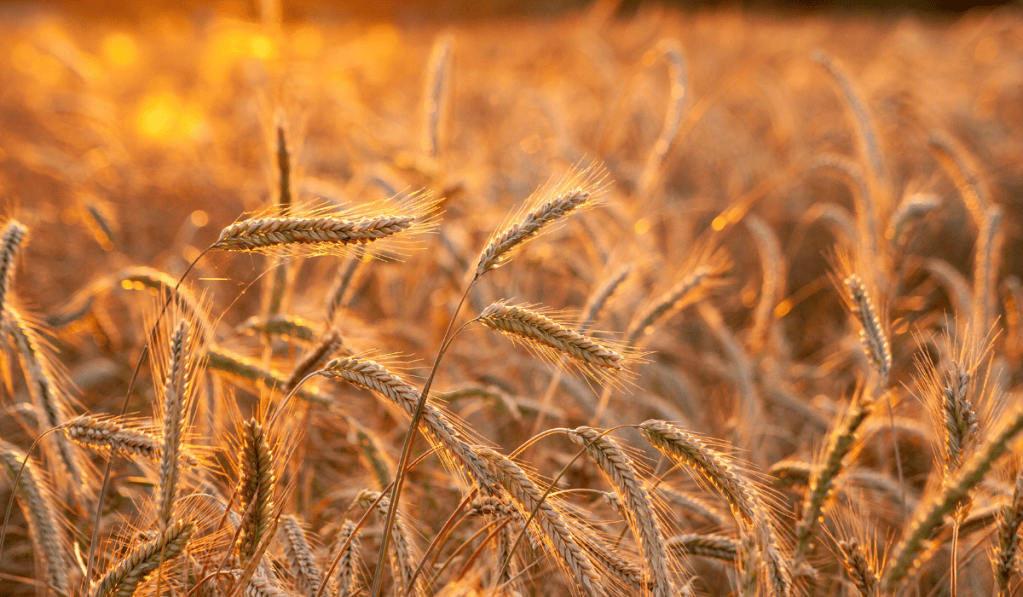
The wheat crop didn’t reach maturity as quickly as barley, so the people had to wait. God told them to wait, to wait fifty days after this first fruits of the barely harvest, until the wheat crop matured enough to also be harvested. They were to wait fifty days, or seven weeks, which is where the name of this feast comes from. The word “Shavuot” is a Hebrew word that means “Weeks.” It is the Feast of Weeks. Thinking again of the other name for this holiday — Pentecost — we see that this name for the feast is also connected with time, with Pentecost meaning fifty, corresponding to the fifty days or seven weeks of waiting between the first fruits of the barley crop to the day of Pentecost itself, when the wheat crop started bearing fruit.
So, what was this holiday celebrating? It was celebrating the beginning of the wheat harvest, and this was truly something to celebrate. Farmers in Israel in the days of Yeshua faced a trying season during this waiting period of 50 days for the wheat crop to begin bearing fruit. Farmers could face potentially dangerous weather that could jeopardize the success of this coming harvest. There was the danger of the dry, hot wind, known as “khamsin” in Arabic, which if it came too early could cause the wheat crop to dry out before it had a time to mature.
They also faced the danger of too much rain. This time of year marked the end of the rainy season, and if the rain continued, excess of rain could ruin the wheat. Today we have techniques such as irrigation and even a water hose to mitigate some of the unpredictable forces of nature that our ancestors had to contend with. But we are still dependent on the help of a greater power, the help of God, whom Yeshua calls the “Lord of the Harvest” (Matthew 9:38, Psalm 104:27). We’re all dependent on Him, and our ancestors were even more aware of just how reliant we are on our Heavenly Father to supply our food and all our needs.
When those first wheat crops started to grow, it was cause for celebration. It was cause to go and run to God and give Him thanks and praise, for He has provided.
Shavuot was a day of celebrating, and it was also a day of giving – of giving thanks to God for His provision, thanking God what He has given us. It was a day of outpouring, of giving.
And that theme continued all the way to that profound Shavuot that the disciples celebrated in the Upper Room as recorded in the Book of Acts. They were joined by thousands of other Jews who had gathered in Jerusalem to celebrate Shavuot and to make offerings to God (Acts 2:5). The disciples and other Jews were following God command for all males to come to the temple in Jerusalem three times a year to celebrate these feasts and present an offering to Him (Exodus 23:17). There was a collective giving on behalf of all the people to God in response for all He had given them.
But there was also the giving of something else on this particular Shavuot. Not only had the Lord provided a blessing in the fields. Not only had He given them crops to present before Him. But He gave them the gift of the Ruach HaKodesh, Holy Spirit, a spiritual harvest. The Ruach, or Spirit, filled the disciples who had gathered in the Upper Room, and He enabled them to speak the message of the Gospel to those who were gathered in Jerusalem for Shavuot, Pentecost.
Through the words that the Spirit gave Peter to speak, thousands, approximately 3000, were cut to the heart and repented (Acts 2:38). Then these were given the gift of salvation, and finally they too were given the gift of the Ruach HaKodesh (Acts 2:38). God had poured out crops in the fields, but He also poured out the gift of something more, of something greater: His salvation, and His Spirit, the Spirit Who confirmed and repeated this message of salvation to all who would hear.
Prior to the outpouring of the Ruach HaKodesh, the Holy Spirit, the disciples were waiting in the Upper Room, praying, pensively waiting for what was next (Acts 1:14), just like the farmers waited for the crops to come. But then the Lord sent the harvest. The disciples’ hearts were filled with the Spirit, and those they spoke to shared in that gift by receiving the message of the Good News preached to them.
Shavuot, Petnecost, is a holiday about giving: of God first giving something to His people, and then of God wanting us as recipients of the gift to give that gift to those who need it. What was the purpose of the gift, of the giving of the Spirit? Was it just for the disciples to remain in the upper room and speak to themselves? No, the Spirit, the gift, was to be used to go outward. Yeshua told His disciples before He left: “But you will receive power when the Ruach HaKodesh (the Holy Spirit) has come upon you; and you will be my witnesses in Jerusalem and throughout all Judea, and Samaria, and to the end of the earth (Acts 1:8). The Spirit was given in order to send the disciples out so that they could speak to those who needed it, and to those who had yet to hear.
Even before the particular Shavuot, or Pentecost, on which the Holy Spirit was given, there have been themes of giving that have long been woven into this holiday. A Jewish tradition on Shavuot that developed over the years was the reading of the book of Ruth on this holiday of Shavuot. Why is this? Why read the book of Ruth? There are a few reasons, but one of which is the fact that the book of Ruth is believed to have taken place around the time of Shavuot, Pentecost. Ruth, in Ruth 2:2, says to Naomi, “Please allow me to glean and gather among the barley sheaves behind the harvesters.” Harvesting barley would have happened at this time of year, near the holiday of Shavuot, just before the wheat crops began to be ready to be picked.

Ruth, if one remembers, was a foreigner. She and her mother-in-law, Naomi, were in need. And written in God’s law was a provision for people like Ruth and Naomi. Leviticus 19:9 says, “When you read the harvest of your land, you are not to reap the very corners of your field, nor are you to gather the gleanings of your harvest […] instead, you are to leave for the poor and for the outsider; I am the Lord your God” (Leviticus 19:9-10).
In fact, this command gets repeated in the actual directions for celebrating Shavuot as mentioned in Leviticus chapter 23. After giving the instructions on how to celebrate Shavuot, God adds, “Now when you reap the harvest of your land, you are not to reap to the furthest corners of your field or gather the gleanings of your harvest. Rather you are to leave them for the poor and for the outsider.” (Leviticus 23:22).
Written in God’s directions for harvesting, and even in His directions for celebrating this holiday, is the concern for those who have none. In addition to our being given something – the fruits of the harvest, the Holy Spirit – we are to be concerned with those who are lacking. In other words, part of what we are to be doing with the harvest is seeing how it can be shared; we should be seeing how we can reach others. The harvest, the crops, the Ruach HaKodesh, has been given to us in part so that we too can give. Again, Jesus told His disciples that His Spirit would be given so that they would be His witnesses (Acts 1:8). There’s a goal at the end of the giving.
Who is poor among you? Who is in need? Who needs to hear the message of salvation?
Yeshua gives us an example. He was tired and thirsty just like we often are (John 4:6). Yet He notices a woman, a woman who was all alone when she should have been with other women (John 4:7), a woman who had had five husbands (John 4:18). He discerned her story. He discerned her need. And He spoke to her, and He changed her life (John 4:28).
When the disciples saw this, they were amazed (John 4:27), and though they didn’t question Him about it out loud, they pressed Him about something else: “Rabbi, eat!” they said (John 4:31). And Jesus responded to them, “I have food to eat that you know nothing about […] my food is to do the will of the One who sent me and to accomplish His work. Don’t you say, “Four more months, and then comes the harvest? Look I tell you, lift up your eyes and look at the fields! They are white and ready for the harvest (John 4:34).”
As believers, we have been blessed by the harvest God has brought into our lives: the physical gifts He’s given us, the spiritual gift of Salvation that He has given us, and the gift of the Ruach HaKodesh with whom He has blessed us and equipped us. And now He calls us to look outward, to see the fields that are waiting to hear the message, other women at well who need to hear the Gospel, other men traveling on chariots who are unable to understand the Scripture, people who are lost in this world, the many, many souls that need to hear the name of Yeshua and know of His deep power and love, those who have yet to know Him.
Shavuot, Pentecost, is a holiday about giving, of being given the fruit of the land, the harvest. Now it is our turn to go out and give.
As you ponder this, I encourage you to listen to the voice of the Ruach HaKodesh, the Holy Spirit. Philip, the man of God, was sensitive to the voice of the Ruach in his life, and he heard the Spirit telling him to run up to that chariot and speak to the man seated upon it.
Who is the Lord calling you to speak to, to minister to, to share a word with, as the generous Holy Spirit would give you the ability to do?
May our Good Father in Heaven, the Lord of the Harvest, direct us according to His will. Amen.